Sanjukta Moorthy
Planning, Monitoring, Evaluation, and Learning
Justice, Equity, Diversity, and Inclusion
Shifting power by mainstreaming participatory and decolonial approaches to social impact
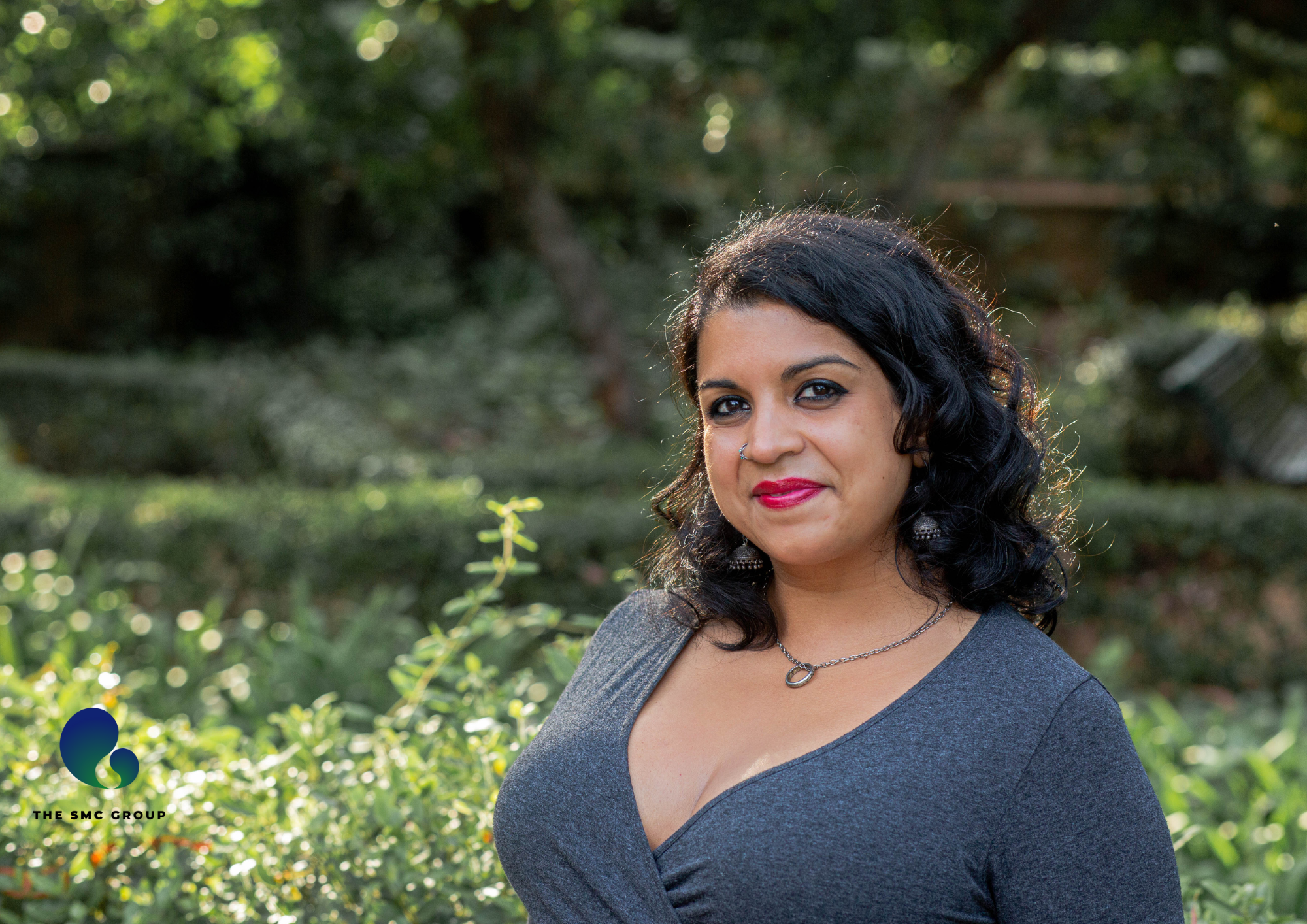
I’m Sanjukta Moorthy
I specialise in participatory, decolonial, intersectional, and inclusive approaches to social impact.
Through creativity and innovation, my work helps shift power in our sector.
Planning | Monitoring | Evaluation | Learning
Justice | Equity | Diversity | Inclusion
Over the past 20 years, I have supported women’s organisations, participatory funders, human rights groups, UN agencies, and NGOs to become more community-led and localised. I’m a specialist in strategy, M&E, and program design. I also help build stronger organisations whose practices match their values.
I bring my cross-cutting expertise from decades in activism, journalism, and the ethical fashion industry. My work reflects on the role of power and history. It is grounded in lived realities and experiences, and centres communities’ expertise. The SMC Group also creates bespoke resources and tools, shared freely to break the elitist paywall they normally hide behind. You’ll find it all in my blog, ‘Behind M&E Lines’.
Decolonising PMEL involves recentring the people we work with and those most marginalised, adapting our politics and approaches to ensure the full participation of everyone in our communities. It also involves restorative justice. All my work also has a strong core of climate justice and gender politics.
Why PMEL?
I find planning, monitoring, evaluation, and learning so fascinating because it helps us articulate our values and goals, and build structures to help us get there.
It’s the beating heart of a social impact organisation. It’s the only way we can really understand our roles in our ecosystem, and the changes we’re working towards.
It holds us accountable to our teams, communities, funders, and the general public. It is highly creative, draws from multiple disciplines, and allows us space to think, reflect, adapt, and grow our work. At least, the way I do it!
Shifting Power
My Methods
I create and use alternate frameworks and methodologies, including decolonial, adding an intersectional feminist lens, and being more inclusive. A lot is being spoken about what’s wrong with how our sector does M&E and strategy design. But no one has offered an answer yet, and that’s a gap I’ve been filling for years.
I also use mixed methods and participatory approaches in all of my work. This is a conscious effort to focus on our sociopolitical, cultural, and geographic realities and break the natural bias that the research field has towards quantitative data! Stories, values, cultural norms – all have been sidelined for too long.
I make use of creative and innovative methodologies like storytelling to write case studies, to bring the human element of our work to life so that ‘development’ is not seen as just targets on a logframe, but sustainable and meaningful work that we do to truly empower and champion our communities’ voices.
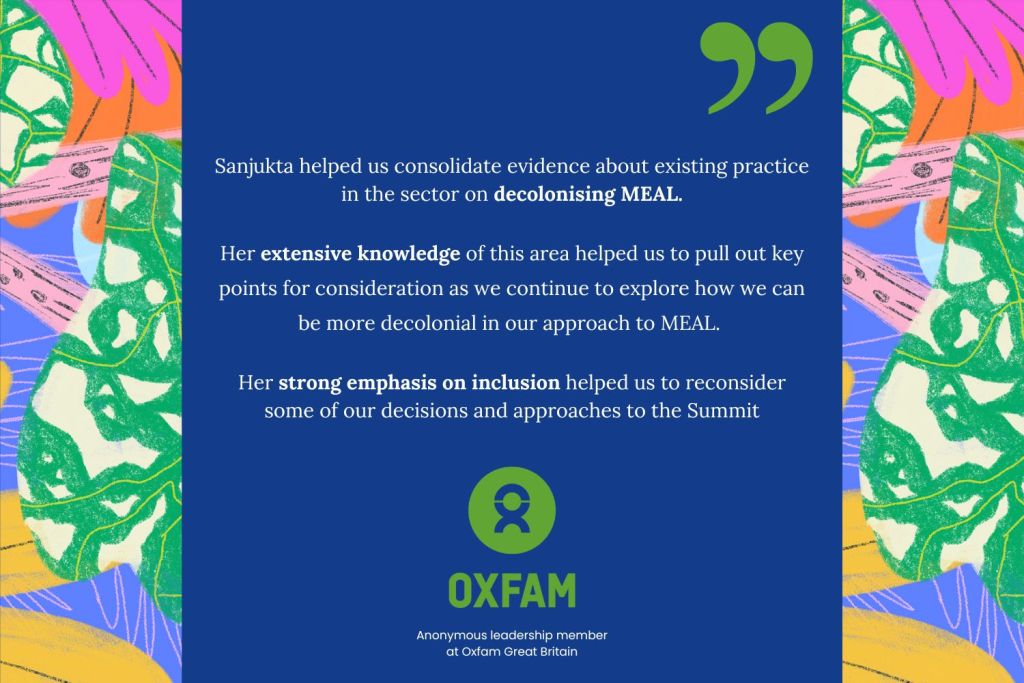
Resources and ‘Behind M&E Lines’: free, high-value resources to support your work
The SMC Group also creates bespoke resources and tools, shared freely to break the elitist paywall they normally hide behind. You’ll find it all in my blog, ‘Behind M&E Lines’.

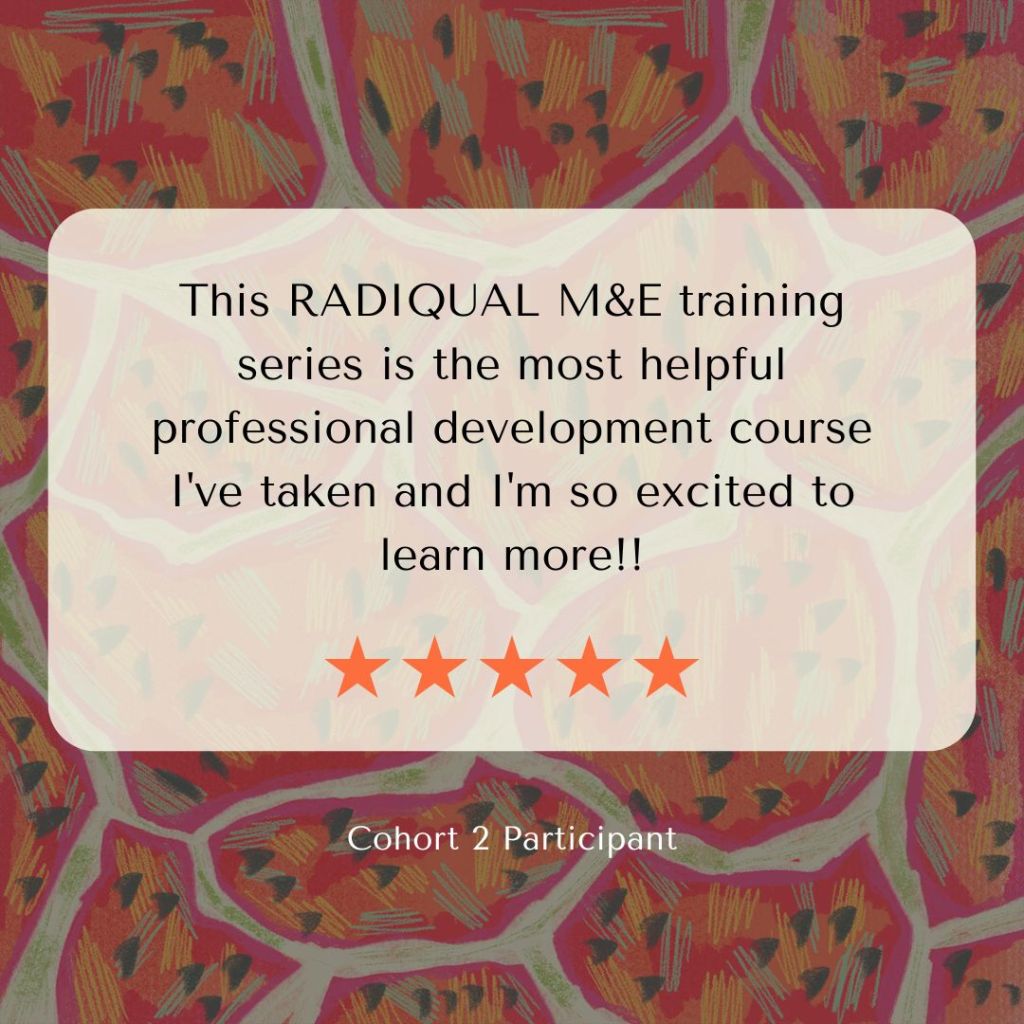
RADIQUAL M&E Course: mainstreaming innovation in social impact
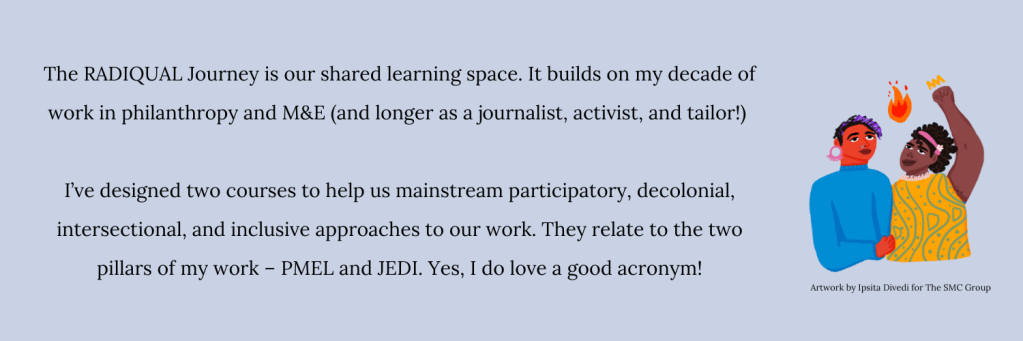
I designed the RADIQUAL Framework and Methodology in 2018, and use it as my values guide to shift power. Read more about it here.
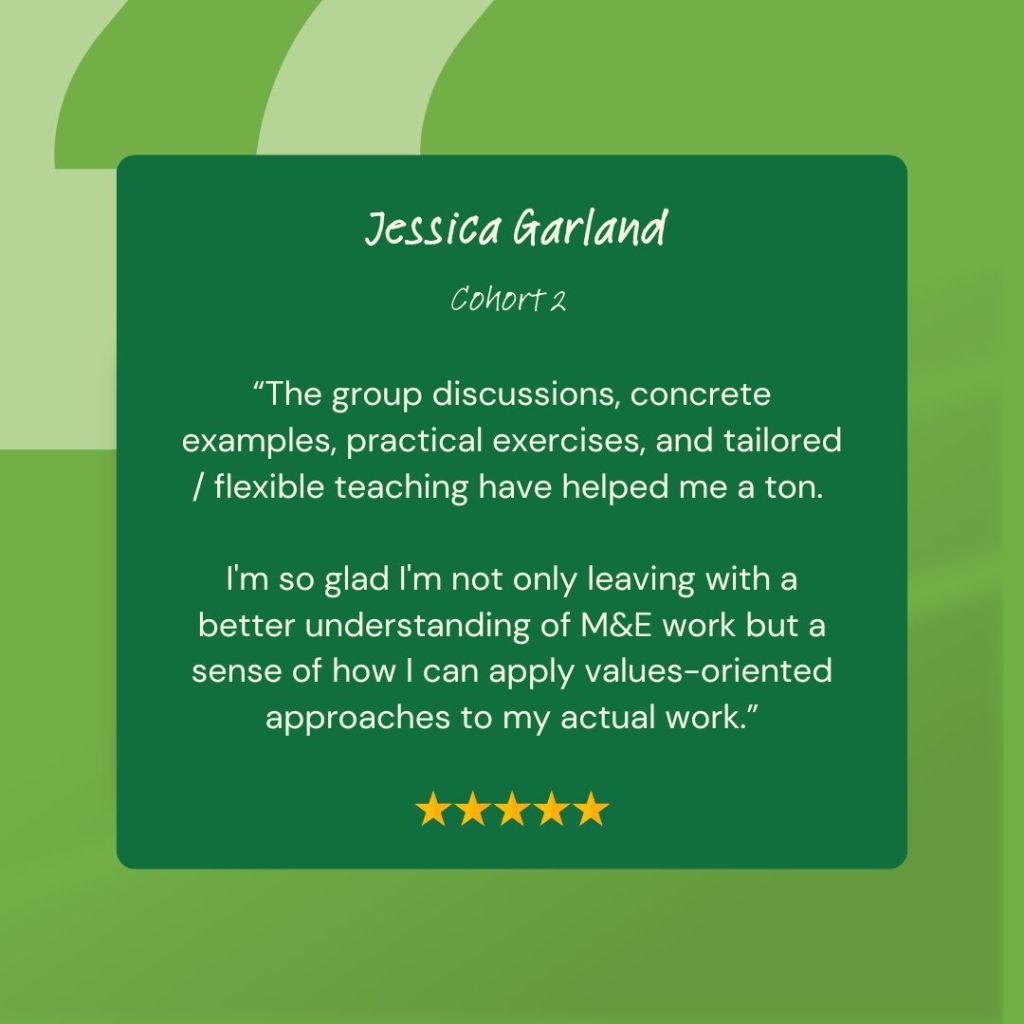
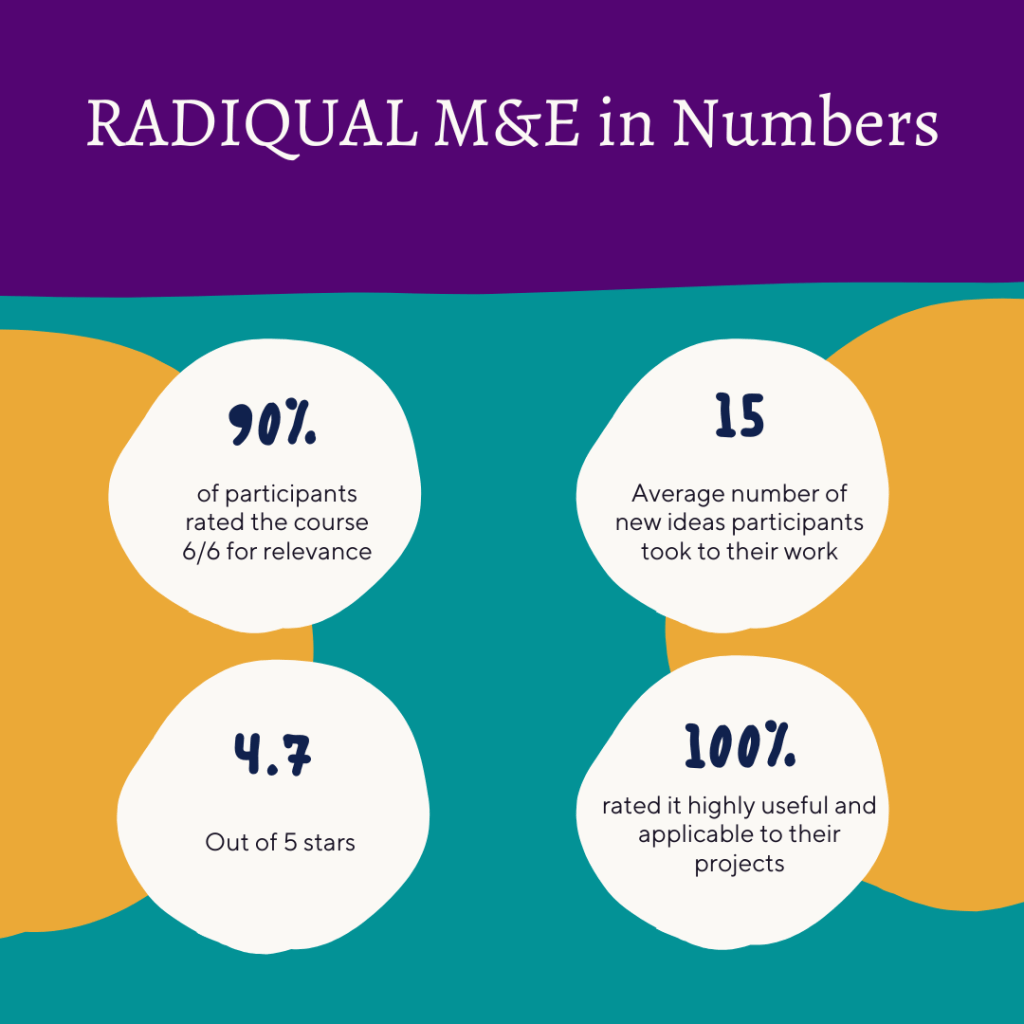
I designed a course based on it, that involves critically evaluating our place in society and how change happens beyond the buzzwords. It’s for anyone in social impact and M&E who wants to build a system and tools that work together – and that are responsive and community-led. We’ll discuss how to articulate and then practice our values.
This course is for M&E practitioners at all levels, and at any organisation—implementer, funder, intermediary, or institutional. You may be involved in strategy, programme, or project design. Maybe M&E is part of your role, or you’re involved in communications, knowledge management, or fundraising.
You should have a basic understanding of M&E ideas and systems and some experience implementing them. This experience has shown you something is missing, and you want to find better ways to do your work that are responsive to your communities’ needs and represent your values.
What It Includes
We will start with a critical review of existing knowledge and frameworks. Through interactive sessions and group work, we’ll consider how to adapt them to our needs or start from scratch and propose completely different alternatives. During the course, you’ll get:
🌿 50+ practical tools, workbooks, and guides I designed specifically for the course*
🌿 2 detailed action plans for you or your organisation with at least 3 ideas*
🌿 personalised online space for your reflections*
🌿 bespoke support to learn in the best way for your needs*
🌿 a shared manifesto that you’ll write with coursemates*
🌿 critical reviews of existing knowledge and frameworks*
🌿 26 ideas to challenge current norms and practices and promote innovation*
🌿 daily interactive sessions, group, and individual guided work*
🌿 reflections to help your learning journey continue in the long term*
🌿 slides and other session materials
🌿 a detailed participant handbook with readings, reflections, and ideas to support your learning
🌿 a library of over 100 multimedia resources and tools
🌿 dozens of peers to support you on your journey
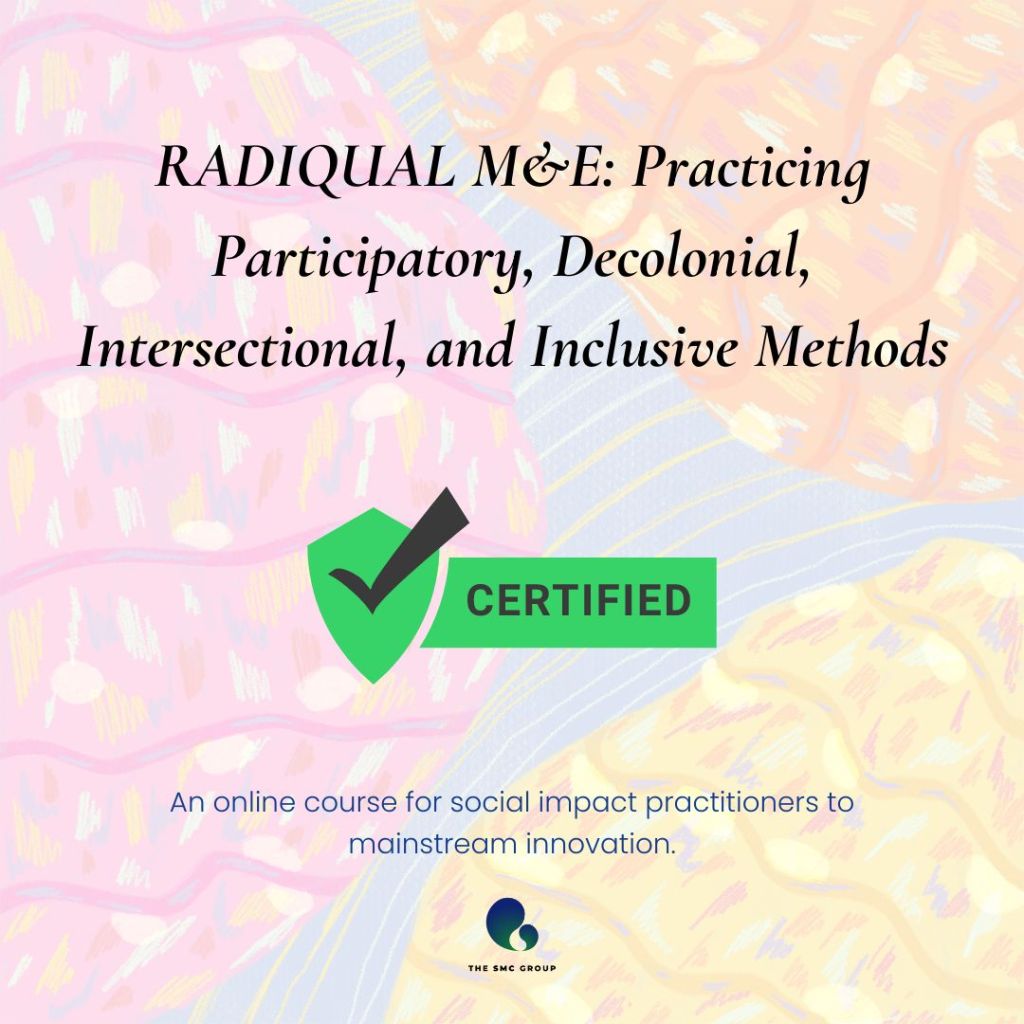
🌿a verified certificate, hosted by The SMC Group, to display on your CV and LinkedIn
* Some materials are only available in the full version of the course (The Roadmap)

Why we need to shift power
We have accepted the traditional ways of doing development work without innovating too much. We’ve accepted that the ‘Western’ (Eurocentric, US-centric) way to do things is the way to do something. Traditional evaluation can be highly extractive and paternalistic. It views people as beneficiaries, not as central to the work, and people with agency and power of their own. PMEL agendas are also largely donor-led, without the implementing organisation, its grassroots partners, or communities dictating the agenda for philanthropy, designing the project, or conducting the evaluation.
It’s mostly stayed the same for many decades, but I do see our sector slowly evolving. That’s so exciting and it’s so inspiring to be part of that change, helping our practices match values.
What I Do
Skill & Expertise Building
I work to build comfort and deepen your expertise.
This includes activities, training, consultations, coaching, and other creative ways to deepen your knowledge in specific areas of PMEL or JEDI+.
Workshops & Facilitation
Workshops involve co-learning with your partners and communities.
These are interactive, bespoke sessions that delve deep into topics and learn from other industries. Sessions can be in-person, hybrid, or online.
JEDI+
Justice, Equity, Diversity, and Inclusion+ support through a progressive lens.
Services are based on your needs and could involve bespoke consultations, strategic support, training, event facilitation, courses, and tools.
Talks & Events
I regularly speak about innovative methods to raise awareness and help mainstream them.
This includes workshops, public talks, speaking on panels, podcasts, guest articles, and other publications. Events can be verbal, visual, or a combination, and are in English.
Advisory & Technical Support
I provide bespoke technical, consultation, and strategic support to support your projects.
Advisory support supplements your work, and technical support fills gaps. This includes impact assessments, evaluations, and supporting your PMEL teams.
Latest Articles
-

Practical Steps Towards Participatory PMEL
Once you’ve designed your PMEL framework and strategy, and decided to centre participatory philosophies and approaches, what’s next? How can…

Read more about radiqual




Contact The SMC Group
How can I support your work? I would love to hear from you.
I read all messages thoroughly and will get back to you within three working days.